
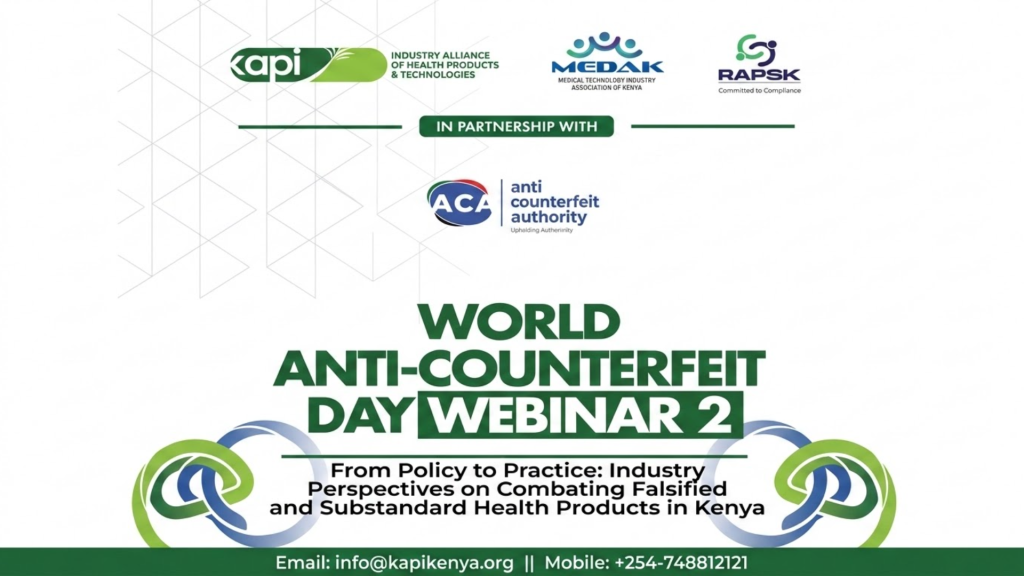
Building on the momentum of the first World Anti-Counterfeit Day (WACD) webinar – which brought together regulators to address the growing threat of falsified and substandard health products – Kenya’s health sector reconvened on June 16, 2026, to take the dialogue a step further.
Hosted by the KAPI – Industry Alliance of Health Products and Technologies, the second session shifted focus from policy and enforcement frameworks to practical, industry-led solutions. Under the theme “Policy to Practice: Industry Perspectives on Combating Falsified and Substandard Health Products in Kenya,” the webinar brought together pharmaceutical innovators, technical experts, and supply chain actors to explore how collaboration and technology can better protect patients and strengthen the healthcare ecosystem.
Opening the session, moderator Dr. Robert Miano and KAPI Chairperson Dr. James Mokoro underscored that while strong regulatory systems are essential, their impact depends on effective and consistent implementation across the supply chain. They emphasized that falsified and substandard medicines remain a complex and evolving global challenge – one that requires sustained industry leadership, shared responsibility, and closer collaboration among all stakeholders.
Speakers highlighted both the scale of the problem and practical approaches to addressing it. Rodgers Kimutai of Haleon outlined the diverse nature of pharmaceutical crime, including counterfeiting, product tampering, diversion, and illicit parallel imports. He emphasized the importance of vigilance across the supply chain, encouraging stakeholders to strengthen detection capabilities and work closely with regulators to improve surveillance and response.
The discussion then turned to the role of technology in strengthening supply chain integrity. Nelson John of GS1 Kenya demonstrated how global standards and digital tools – such as unique product identifiers, Data Matrix codes, and mobile verification – are enabling greater traceability and transparency. These solutions allow healthcare providers and patients to verify product authenticity more easily, reinforcing trust in the system.
Taking a broader view, Juma Mwashuruti of Novartis highlighted the increasing sophistication of illicit networks across Africa, particularly in targeting high-value medicines such as oncology and transplant therapies. He called for stronger cross-border collaboration and more coordinated enforcement efforts to address the transnational nature of the threat.
Practical implementation was further illustrated by Avishek Chattopadhyay of GSK, who shared insights from pilot projects focused on real-time product authentication. He highlighted the UNICEF-supported “Trvst” platform, which integrates serialization, secure data sharing, and monitoring dashboards to enhance visibility across the supply chain. These systems, he noted, rely on accurate data and close collaboration with governments to be effective.
Dr. Prudence Baliach of Roche reinforced the urgency of the issue, pointing to the continued risks posed by falsified medicines, particularly for complex and high-value treatments. She outlined a layered approach to mitigation – including tamper-proof packaging, digital verification tools, and improved reporting – while calling for greater awareness and collective action to address persistent gaps.
The session concluded with an interactive discussion led by Chrispine Abuya of Reckitt, where participants reflected on implementation challenges and opportunities for stronger collaboration, before being closed by Dr. Peter Odhiambo of Bayer. A consistent message emerged: patient safety must remain at the center of all efforts.
As a continuation of the earlier dialogue, the webinar marked a clear shift from awareness to action – demonstrating how stronger partnerships, digital innovation, and coordinated implementation can help safeguard Kenya’s healthcare system from falsified and substandard products.